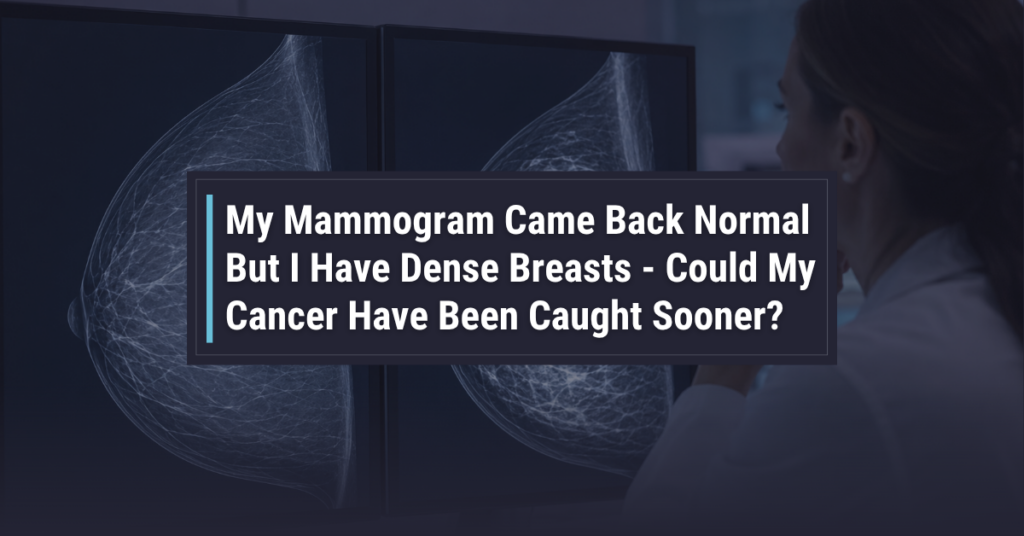
Mammograms are a leading way to detect breast cancer early, but dense breasts can sometimes obscure warning signs of breast cancer on mammograms. Because of this known issue, federal and state guidelines require mammography facilities to notify patients that mammograms may not be conclusive. Doctors should know this, but they may still make mistakes or forget, which can result in breast cancer spreading and advancing.
If your mammogram came back as normal, you have dense breasts, and your cancer has progressed, you should seek legal consultation with an experienced medical malpractice attorney. The award-winning attorneys at Powers and Santola, LLP are here to advise you of your legal rights and options. Call us today for a free consultation.
The Connection Between Dense Breasts and Breast Cancer
Dense breasts have a higher proportion of fibrous and glandular tissue than fatty tissue. The problem with dense breasts is twofold. First, dense breasts are associated with a higher rate of breast cancer. Breast cancer might grow in dense breasts. Second, dense breast tissue and tumors both appear white on a mammogram, so that they can obscure cancerous growths.
State and Federal Guidelines Regarding Mammograms and Dense Breasts
Because dense breasts can potentially hide cancerous growths, they can contribute to a delayed breast cancer diagnosis; because of this, state and federal Food and Drug Administration (FDA) guidelines have been established.
Federal FDA Guidelines
Beginning September 10, 2024, mammography facilities must provide all patients who receive a mammogram with a written notification statement. The notice they receive depends on whether they are classified as having dense breasts or non-dense breasts. The mammogram report that is sent to the referring medical provider must also include an assessment of the patient’s breast density.
Federal FDA Guidelines
New York State law requiring notification of dense breast tissue after a mammogram took effect about a decade before the federal mandate, making it one of the first states to require such notifications. Under state law, doctors or facilities that provide mammograms must notify people if a mammogram shows that they have dense breasts and the impact it can have on their breast health. Specifically, the notification explains that dense breast tissue can make it harder to detect cancer on a mammogram and is associated with an increased risk of cancer.
Radiologists list four categories of breast density. Under New York law, radiologists must report dense breasts when the mammogram indicates the patient has one of the two highest levels of breast density: extremely dense or heterogeneously dense. The letter patients receive encourages them to talk to their healthcare provider about their individual risk factors for breast cancer and to determine if more screening tests, such as a screening ultrasound or MRI, are necessary.
Additionally, New York law requires insurance companies to provide coverage for annual comprehensive breast ultrasounds for patients with dense breasts because dense tissue makes standard mammograms less effective.
What Can a Healthcare Provider Do If I Have Dense Breast Tissue?
If you have dense breast tissue, a doctor can order additional testing to confirm whether you have breast cancer, such as:
- Whole-breast ultrasonography, which utilizes sound waves to create images of the entire breast tissue and is sometimes used to detect small cancers or lesions that may not appear on mammograms
- Magnetic resonance imaging (MRI), which uses magnets, radio waves, and a computer to create detailed pictures of internal structures of the body, is more sensitive than traditional mammograms for detecting breast cancer.
- Molecular breast imaging, which makes tumors appear on a test by using a radioactive tracer, is up to four times more effective in detecting breast cancer in dense breasts than mammograms alone.
- Tomosynthesis, which is a 3-D mammogram that helps reduce false negatives
The imaging that your medical provider recommends should be based on your individual circumstances, health history, and other factors specific to your situation.
The Concern with False Negatives
The major concern with dense breasts and mammograms is that you can be given a false negative. This means that a healthcare professional has reviewed your mammogram and said that there is no cancer when there really is, and the cancer can grow undetected.
When cancer is caught in its early stages, where it is localized, it has a greater than 99% five-year survival rate. However, if breast cancer is allowed to spread outside the breast to nearby structures or lymph nodes, the survival rate drops to 87%. It falls to a devastating 32% if the cancer spreads to distant parts of the body, such as the lungs, liver, or bones.
Even when a patient can survive a more advanced stage of cancer, the consequences are still significant. They may have to undergo more aggressive forms of treatment, including getting a mastectomy. They may be subjected to harsher treatment and undergo significant pain and suffering. They also suffer emotionally as they contemplate their mortality.
When a healthcare provider’s negligence is responsible for these consequences, injured patients can pursue a medical malpractice claim.
When Does a Healthcare Provider Commit Medical Malpractice?
Medical providers could commit malpractice related to dense breasts in many ways, including by:
- Failing to order a mammogram
- Failing to account for dense breasts
- Failing to notify a patient of their dense breasts and what this means for their health
- Failing to order other diagnostic testing
- Failing to follow up after an abnormal finding
A successful medical malpractice claim proves the following legal elements by the preponderance of the evidence:
Duty of Care
The duty of care in a medical malpractice case is defined as the standard of care that another medical professional in the same specialty and geographic area would provide under similar circumstances. This duty of care in a dense breast cancer case includes notifying the patient of their status and considering other imaging options.
Breach of Duty
The breach of duty is what the medical provider did that deviated from the accepted standard of care. For example, if another oncologist would have ordered follow-up testing and yours didn’t, your doctor may have violated the duty of care.
Causation
Causation connects the healthcare provider’s actions or inactions to your negative outcome. It is common for doctors, radiologists, and other defendants to try to argue that you would have still had cancer even if they hadn’t made a mistake. However, in these cases, the question usually becomes, “Would the cancer have spread or advanced in stage if the mistake had not occurred?” If you can prove that your late-stage cancer diagnosis stems from a false negative or other oversight regarding dense breast tissue, you may be able to establish this legal element.
Damages
Damages are the various losses that you suffer because of the incident. In delayed breast cancer diagnosis cases, common damages that patients may suffer could include:
- Additional medical treatment costs
- Rehabilitation and therapy costs
- Physical pain and suffering
- Mental anguish
- Reduced life expectancy
Your medical malpractice lawyer can guide you through the legal process and assist you with all aspects of your case.
How a Medical Malpractice Lawyer Can Help with Your Legal Claim
After you have received a potentially fatal diagnosis, the last thing you want is to have to deal with a complex legal claim on your own. Fortunately, you don’t have to. The experienced legal team at Powers & Santola, LLP can complete the following essential functions of your medical malpractice claim.
Reviewing Your Medical Records
Any medical malpractice case begins with a meticulous review of the medical records. We can request your records, review them, and give you an honest assessment about the viability of a potential medical malpractice case.
Identifying All Responsible Parties
Breast cancer misdiagnosis cases may involve multiple defendants, such as:
- The radiologist who missed the cancer on the mammogram or underreported findings
- The mammography facility that failed to notify you of the dense breast tissue issue
- The primary care physician who failed to give you options for other imaging that could have detected the cancer
- An oncologist who failed to escalate the issue
- Hospitals or health systems with policies that contributed to the problem
Building a Timeline of Events
Our medical malpractice lawyers and medical experts can build a compelling timeline of events showing when each step in your cancer journey occurred and how your prognosis could have improved. We obtain mammography results, other imaging results, doctor’s notes, communications regarding dense breast tissue, and other medical records to identify the earliest point when the cancer could have been detected. We then work with our experts to determine what your medical team should have done to ensure that it was.
Working with Expert Witnesses
New York medical malpractice lawsuits must include a certificate of merit that explains why the situation establishes the legal grounds for a medical malpractice case in the state. Then, at trial, a medical expert will need to testify about the standard of care and your healthcare provider’s deviation from it. At Powers & Santola, LLP, we have a nationwide network of experts in various fields who can help support our clients’ claims.
Accounting for the Full Extent of Your
Delayed diagnosis can lead to several types of damages, including physical, emotional, and financial. Our lawyers identify all the losses you have experienced and fight for full and fair compensation.
Why Should I Hire Powers & Santola, LLP for My Delayed Breast Cancer Case?
Some of the characteristics that set Powers & Santola, LLP apart are:
- Hundreds of millions of dollars in life-changing compensation for our clients
- Over 40 years of legal experience
- Attorneys recognized by U.S. News & World Report and Best Lawyers in America as one of the nation’s best medical malpractice law and personal injury firms.
- Recognition as Medical Malpractice Lawyer of the Year and Personal Injury Lawyer of the Year
Contact us today to speak to one of our attorneys to learn the difference of working with our award-winning team.
What Is the Deadline to File a Delayed Cancer Diagnosis Case in New York?
Most medical malpractice lawsuits must be filed within two and a half years of the negligent act or the end of continuous treatment for the condition. However, a special rule applies in delayed cancer diagnosis cases. In these cases, the deadline is two and a half years from the date the patient discovers, or reasonably should have discovered, the misdiagnosis, subject to a maximum seven-year time limit.
Because the window to file a medical malpractice lawsuit is limited, you should reach out to an experienced medical malpractice attorney as soon as possible to protect your legal rights.
What Is the Deadline to File a Delayed Cancer Diagnosis Case in New York?
If you received a false negative for breast cancer, have dense breast tissue, and later received a diagnosis of breast cancer, an experienced attorney from Powers & Santola, LLP can help explain your legal rights and options.
Your healthcare team should have treated you in accordance with the highest standards and the medical knowledge available at the time regarding this known issue. Our legal team is here to help you demand the justice and accountability that you deserve. Contact us for a free consultation.