If a lung nodule showed up on your CT scan and your healthcare provider never followed up, you may have a viable medical malpractice case if your lung cancer was allowed to progress. Healthcare professionals are expected to follow established guidelines based on the size and classification of such nodules. They can be held responsible when they fail to do so.
The experienced medical malpractice lawyers at Powers and Santola, LLP can discuss your legal rights and options during a free consultation. For over 40 years, our attorneys have fought to protect the rights of people injured in New York due to the negligence of others. Call us today to take advantage of your free, no-obligation consultation.
What Is a Lung Nodule?
According to the American Thoracic Society, a pulmonary nodule, or lung nodule, is a round area in the lung that is denser than normal lung tissue. It is typically three centimeters or less in diameter, with most being less than ten millimeters (about a ½ inch). Masses that are larger than this are classified as lung masses.
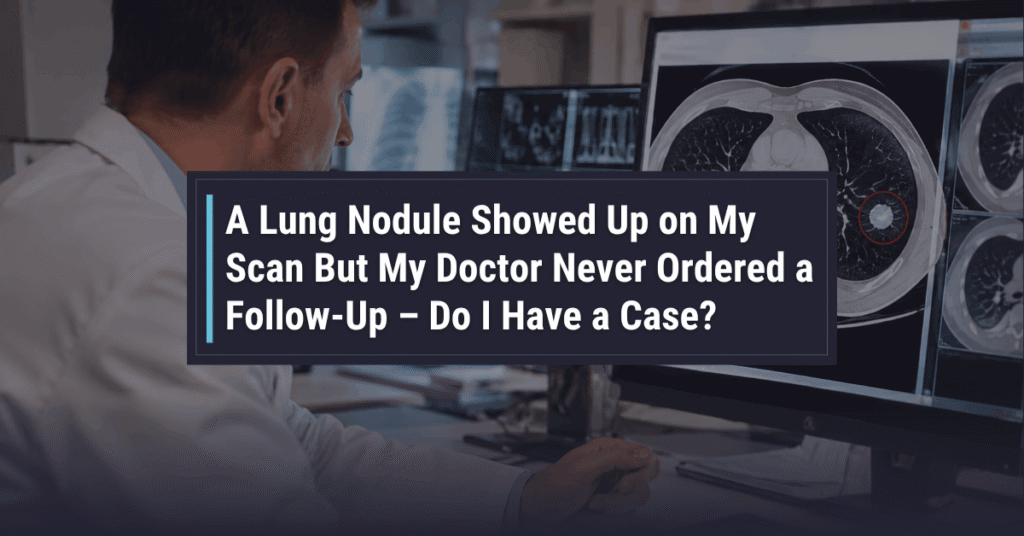
These nodules show up as white spots on CT scans, which is why they are sometimes referred to as a “spot on the lung” or a shadow. A nodule can be an early lung cancer.
What Can Lung Nodules Indicate?
Lung nodules don’t always indicate cancer. Most lung nodules are benign, especially smaller ones under one centimeter. They may be scar tissue, a healed infection, or the result of exposure to an airborne irritant. Fewer than five percent of all lung nodules are cancerous.
Still, the correlation between lung nodules and lung cancer is well-documented. Therefore, if an imaging scan identifies a lung nodule, proper follow-up is essential to ensure a timely diagnosis.
Standard Follow-Up Protocols for Nodule Size and Classification
Follow-up may be recommended if a lung nodule is found, depending on its size and classification. Healthcare professionals may follow different guidelines to determine the appropriate response.
One of the most popular guidelines is the Fleischner Society Guidelines. Follow-up protocols under these guidelines depend on the nodule’s size, anatomical location, composition, patient risk factors, and standardized classification systems used to assess malignancy risk. Under these guidelines, the following recommendations generally apply:
- Solid nodules less than six millimeters: No routine follow-up is generally required if the patient is considered low-risk. However, high-risk patients may be recommended to obtain a follow-up CT at twelve months, especially if the nodule is in the upper lobe or has suspicious morphology.
- Solid nodules six to eight millimeters: Medical professionals will generally recommend a follow-up CT imaging at six to twelve months, followed by another at eighteen to 24 months, depending on the nodule’s stability.
- Solid nodules greater than eight millimeters: More aggressive evaluation is required for larger nodules, such as short-interval CT scans at three months, a PET/CT scan, or tissue sampling.
- Subsolid/ground-glass nodules: For subsolid or ground-glass opacities, different recommendations may apply, including:
- No routine follow-up for nodules less than six millimeters
- An initial CT at six to twelve months, followed every two years for five years, for pure ground-glass nodules that are six millimeters or larger
- An initial CT at three to six months for part-solid nodules, with biopsy or surgery considered if the solid component grows greater than six millimeters
Radiologists should include specific follow-up recommendations in the imaging report so other healthcare providers can act appropriately. The ordering physician should communicate findings to the patient and ensure follow-up occurs.
If nodules grow between follow-up images, further evaluation should be undertaken, such as a PET scan or biopsy.
These guidelines do not apply to all patients. They must be adapted to the individual patient context. Specifically, they do not apply to the following types of patients:
- Patients younger than 35: Younger patients have a lower overall risk of pulmonary malignancy. Nodules in this age group are most likely to be infectious rather than cancer. The guidelines recommend individualizing management for pulmonary nodules in this group.
- Patients with a known malignancy: Patients who have a known malignancy are more likely to have nodules that are cancer-related than those in the general population, so healthcare providers should take any nodule seriously.
- Immunocompromised patients: Patients with conditions that affect their immune system have a higher risk of opportunistic pulmonary infections, so nodules are more likely to be infection-related than cancer-related.
- Patients on active screening: Patients receiving active screening due to a high risk of developing lung cancer should have their scans reported according to Lung Imaging Reporting and Data System standards (RADS). This group includes current and former smokers.
What Does It Mean If My Doctor Didn’t Follow Up After Seeing a Lung Nodule and Not Following Up?
Clinicians must assess the risk of a nodule’s malignancy by considering factors such as:
- Size of the nodule
- Whether the nodule has multiplied
- The nodule’s attenuation
- Older age
- Heavy smoking
- Upper lobe location of the nodule
Ultimately, the clinician must individualize the recommendation to the patient using clinical judgment and/or a validated model.
When a medical provider detects a nodule but does not follow up appropriately according to the guidelines, they may have deviated from the standard of care that other healthcare professionals would have provided under similar circumstances. An experienced medical malpractice attorney from Powers and Santola, LLC can discuss your situation during a free case review. Contact us today to learn more.
The Dangers of Not Following Up After Detecting a Lung Nodule
Prompt diagnosis of cancer is essential to having increased survival odds and better treatment options. When healthcare providers follow the guidelines after detecting a lung nodule, they can take action that leads to an accurate diagnosis, such as:
- Comparing images to a previous image, such as in a CT scan, or repeating a CT scan to determine if the nodule has grown or evolved
- Repeating a low-dose CT scan in one to three months, six months, one year, or longer to determine if the nodule has grown or changed
- Obtaining a more detailed CT scan to determine if the nodule is likely to be cancer
- Completing a PET scan to determine if the nodule illuminates during testing and if similar activity is present elsewhere in the body
- Conducting a lung biopsy to determine if a nodule is cancerous
In the case of lung cancer, by the time that many patients start demonstrating common symptoms associated with the disease – such as weight loss, a persistent cough, or shortness of breath – the cancer may have advanced to a more aggressive stage. A timely diagnosis can easily make the difference between life and death.
According to the American Lung Association, only 28.1% of lung cancer cases are diagnosed at an early stage, when the survival rate is 65%. In contrast, 43% of cases are not diagnosed until a late stage, when the survival rate is only 10%. This factor contributes to lung cancer being the most common cause of cancer-related deaths in the United States.
Even if a late diagnosis is not a death sentence, when cancer is allowed to spread, more complications can arise. More aggressive medical treatments are necessary to fight the cancer, leading to more pain, suffering, and other consequences for patients.
What Do I Have to Prove for a Medical Malpractice Case?
Just because a doctor did not follow up after detecting a lung nodule does not necessarily mean that they have committed medical malpractice. For example, a patient may have been considered low-risk, or the nodule may have been small enough not to warrant follow-up.
The question becomes, “Would another healthcare professional in the same specialty area and geographic region have followed up after detecting the lung nodule?” If the answer is “yes,” you may be able to prove that the healthcare provider deviated from the standard of care. A medical expert will need to testify about what other medical providers would have done under similar circumstances.
Next, you will need to prove harm. You must show that the delay allowed the cancer to progress to a more advanced stage. Again, medical experts are usually necessary to establish the link between a healthcare provider’s actions or inactions and the spread of the cancer.
Common Causes of Lung Nodule Malpractice
Lung nodule malpractice can occur for various reasons and involve various medical providers, including doctors, radiologists, and hospitals. Common scenarios involving lung nodule malpractice include the following:
- The radiologist’s report is lost: Radiologists usually do not have contact with a patient after they complete the scans. Instead, they may include an electronic report in the patient’s electronic medical record. The ordering physician may forget to review it or assume nothing is wrong if they were not directly contacted about the results.
- The radiologist fails to report the nodule: The guidelines require the radiologist to document the nodule in the report so it won’t go unnoticed. However, a radiologist may fail to include the detection in the report.
- The ordering physician fails to act on the follow-up recommendation: Even if the radiologist clearly states that a CT scan should be repeated in six months, the ordering physician, whether an emergency doctor or primary care physician, may fail to request the test.
- The physician fails to notify the patient of the finding: The doctor may fail to inform the patient that they detected a lung nodule. This is more likely in emergency settings, when healthcare providers face immense time pressure and may be less familiar with a patient’s health history. Doctors have a duty to communicate important test results so patients can take protective action.
- The recommended follow-up test is not performed: Even when the problem is identified and the patient is informed, the recommended follow-up may not occur. Imaging testing centers may miss the message or forget to call to schedule the follow-up appointment. Even in these scenarios, doctors should track care and ensure the patient receives follow-up testing.
- The growth is ignored: In some cases, the healthcare team identifies the growth but ultimately ignores it. Nodules that increase in size are cause for concern. When nothing is done in response, cancer can grow unfettered.
An experienced attorney can review your situation to determine if you have a viable medical malpractice claim. We can also obtain your medical records and identify where the communication breakdown occurred, what your medical providers knew, and when.
Contact Our Experienced Medical Malpractice Attorneys for a Free Case Review
At Powers and Santola, LLP, we frequently work with patients who have suffered irreversible harm due to the negligence of medical providers they entrusted with their care. If a radiologist did not communicate that a lung nodule was detected on your scan, your doctor failed to follow up appropriately, or your lung cancer was otherwise allowed to grow undetected, you may have a viable medical malpractice case. If your healthcare provider has violated the standard of care, we want to hold them accountable.
Contact Powers and Santola, LLC today to discuss your legal rights and options in a confidential setting.